You can tell a lot about a dog from the garden.
Stools that are firm one day and not the next. Wind that clears a room. A dog who’s fine for a fortnight and then has three bad days for no reason you can identify. Most owners put it down to something he picked up on a walk, and quite often that’s exactly right – but the reason one dog shrugs off a mouthful of pond water while another is up all night usually comes down to what’s living in his intestines.
The scale of it
There are somewhere in the region of a hundred trillion bacteria in a dog’s digestive tract. Not thousands. Trillions.
Between them they carry vastly more genes than the dog himself does, which means the microbiome performs an enormous amount of metabolic work that the dog’s own body simply cannot do. Researchers sometimes describe it as an organ in its own right, and that’s not far off – it weighs a comparable amount to some of the ones you can actually point at.
It’s also individual. Two labradors in the same house on the same food will have measurably different populations, shaped by how they were born, what they ate as puppies, what medication they’ve had and what they’ve eaten off the pavement since.
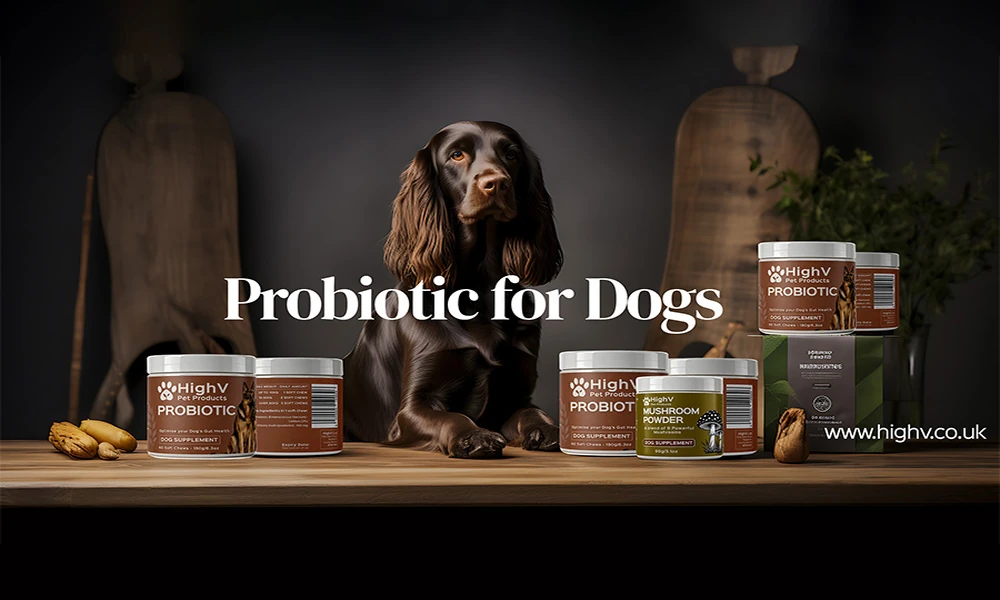
That variation is why blanket advice about digestion so often disappoints, and why supporting the population you’ve got tends to work better than trying to overhaul it. It’s also the argument for feeding Probiotics for Dogs as steady daily support rather than as a rescue remedy after things have already gone wrong.
What the microbiome actually does
More than digestion, which is the bit everyone knows about.
Breaking down what the dog can’t. Fibre in particular. Bacteria ferment it into short-chain fatty acids, and one of those – butyrate – is the primary fuel source for the cells lining the colon. The gut wall is quite literally fed by its own bacteria.
Making vitamins. Vitamin K and several of the B vitamins are synthesised by gut bacteria rather than absorbed from food.
Training and running the immune system. Something in the order of seventy per cent of a dog’s immune tissue sits in and around the gut. The bacterial population is in constant conversation with it, and that conversation is a large part of how the immune system learns what to attack and what to leave alone.
Keeping the bad ones out. A well-populated gut leaves very little room, physically or nutritionally, for anything harmful to establish. This is called competitive exclusion and it’s one of the more underrated defences a dog has.
Maintaining the barrier. The gut lining is one cell thick in places, and its integrity depends partly on the bacteria sitting on it. When that breaks down you get inflammation and poor absorption.
Talking to the brain. The gut-brain axis is real and increasingly well documented. Gut bacteria influence neurotransmitter production, and there’s growing evidence linking microbiome composition to behaviour and stress responses in dogs.
Where it comes from in the first place
A puppy is born with a gut that’s close to sterile, and it gets colonised extremely quickly.
The first wave comes from the mother during birth and in the hours after it – from her skin, her milk and her environment. Colostrum in the first day or so delivers not just antibodies but compounds that actively encourage certain bacterial populations to establish.
By weaning, the population is shifting again to handle solid food, and it carries on developing through the first year. Which means a puppy’s early environment has a long shadow: a litter raised somewhere clean but sterile, or one that had antibiotics early, can start adult life with less microbial diversity than one raised in a busy household with a garden.
You can’t go back and change any of that. It does explain why some dogs seem to have had temperamental digestion from the day they arrived, and it’s a reasonable argument for supporting those dogs steadily rather than waiting for problems.
It’s also why what a bitch is fed during pregnancy and lactation matters more than most breeders account for.
What knocks it off balance
Antibiotics. By far the biggest single disruptor. They don’t distinguish between the bacteria causing the problem and the ones doing useful work, and canine studies show the effects can persist for weeks or months after the course finishes.
Sudden diet changes. The population adapts to what it’s fed. Change the food overnight and you’ve changed the fuel supply faster than the bacteria can adjust, which is why the loose stools appear on day two rather than day one.
Stress. Kennels, house moves, fireworks, a new baby. Stress alters gut motility and secretions directly, which is why stress colitis is such a common presentation after a boarding stay.
Illness, particularly anything involving vomiting or diarrhoea, which physically flushes the population out.
Scavenging. The bin, the compost heap, something four days dead on the beach.
Age. Microbiome diversity tends to decline in older dogs, and diversity is one of the better markers of a healthy population.
What dysbiosis looks like
Dysbiosis is the word for the balance being off. It rarely announces itself dramatically.
What you tend to see is inconsistency. Stools that vary from day to day with no obvious pattern. More wind than seems reasonable. Audible gurgling. Occasional unexplained vomiting. Sometimes a dull coat or itchy skin, because the gut and the skin are more connected than most owners realise.
Persistent or severe signs need a vet rather than a supplement – there are tests now, including a dysbiosis index that measures specific bacterial groups from a faecal sample, and chronic diarrhoea deserves a diagnosis rather than a guess.
Probiotic, prebiotic, synbiotic
Worth getting straight, because the words get used interchangeably and they mean different things.
A probiotic is live beneficial bacteria, fed in a measured dose. You’re adding to the population.
A prebiotic is a fibre that beneficial bacteria feed on but the dog can’t digest himself. Chicory inulin is among the best established. You’re feeding the population you already have.
A synbiotic is both together, which is the sensible approach – adding bacteria without providing anything for them to eat is doing half a job.
A postbiotic is the useful compounds bacteria produce, supplied directly rather than grown in situ. Newer, less common, and worth watching.
The bit that surprises people: they don’t stay
Probiotic bacteria are largely transient. They pass through, do their work, and leave. They don’t set up permanent residence and rebuild your dog’s gut flora into a new configuration.
That’s not a criticism, it’s just how they work – and it has one very practical consequence. Feeding a probiotic for a week and then stopping gets you a week of benefit. If you want the effect to continue, the feeding has to continue.
It also explains why sporadic use disappoints. A tub bought in a panic during a bout of diarrhoea, fed for four days and then forgotten in a cupboard, was never going to do very much.
Strains and numbers
Two things on a label actually tell you something.
The strain. “Probiotics” on its own means nothing. Different bacterial species do different things, and the ones with the best evidence in dogs include Enterococcus faecium, various Lactobacillus species and Bifidobacterium animalis. A product that names its strain is a product that knows what it put in.
The CFU count. Colony forming units – the number of live bacteria per serving. Without it you have no idea of the dose. Look for it stated per chew or per scoop rather than per hundred grams, which is a number designed to look larger than it is.
And check storage. Live bacteria are living things; some products need refrigeration, others are stabilised for room temperature. Follow whatever the label says, because a badly stored probiotic is an expensive placebo.
What they can and can’t do
Honestly: probiotics are useful support, not medicine.
There’s reasonable evidence for shortening bouts of acute diarrhoea, for reducing the digestive fallout of antibiotics, and for helping with stress-related upsets. Owners commonly report firmer, more consistent stools within a week or two of starting.
What they won’t do is fix a food intolerance, cure inflammatory bowel disease, resolve a parasite burden or compensate for a diet that doesn’t suit the dog. If your dog’s digestion is persistently poor, the probiotic is the last thing to sort out, not the first.
Diet does most of the heavy lifting
No supplement outruns the food.
Fibre matters more than people expect. Beet pulp, chicory, pumpkin and psyllium all provide fermentable material, and a diet with essentially none of it starves the population you’re trying to support.
Consistency matters too. Constant food changes, a different topper every week and a rotating cast of treats give the microbiome nothing stable to adapt to.
And go slowly when you do change. Ten days, mixing gradually, is the standard advice for a reason.
Signs it’s going well
Firm, consistent, easy-to-pick-up stools. Roughly the same number of them each day. Not much wind. A dog who can eat something slightly unusual without consequences. Good coat condition and steady weight.
Give any change four weeks before you judge it, and write down what you’re seeing rather than relying on memory – digestion changes gradually and it’s remarkably easy to forget what last month looked like.
When it’s a vet’s job
Diarrhoea lasting more than forty-eight hours, or any diarrhoea with blood in it. Repeated vomiting. Weight loss. Loss of appetite. A dog who seems genuinely unwell rather than just windy.
And any sudden change in a dog whose digestion has always been reliable – that’s worth investigating rather than supplementing, because the useful thing a supplement does is support a working system, not compensate for a broken one.